
Gloucestershire wants Cheltenham West's 14 night firefighter posts moved to Cinderford. Its own figures add 25 seconds here. Consultation closes 28 September.
Cheltenham West fire station would have no full-time crew overnight under proposals Gloucestershire County Council is consulting on until 28 September. Its 14 wholetime night posts would move to Cinderford, in the Forest of Dean, to staff a new daytime crew there.
A petition against the plan had 2,065 signatures when we checked on 1 September, against a target of 2,500.
The county’s own consultation document puts a number on what Cheltenham gives up. The first fire engine would take 25 seconds longer to arrive here on average, and the second 40 seconds longer.
What is actually proposed
The recommended option in the Cabinet report of 22 July is called A3. It redeploys 14 existing wholetime posts from Cheltenham West’s night shift to Cinderford. The report describes this as “effectively removing wholetime night cover at Cheltenham West”.
The 14 posts are 2 watch managers, 2 crew managers and 10 firefighters. Nobody is made redundant. Total headcount across the service does not change.
Under the plan:
- Cheltenham West becomes a wholetime day-crewed station
- Cinderford gains a wholetime day crew, having run on on-call crews only
- Cheltenham East keeps its 24-hour cover, with a wholetime and an on-call engine available at night
- overnight calls in west Cheltenham would be answered from Cheltenham East and other neighbouring stations
Cheltenham West station is on Tewkesbury Road at Uckington, GL51 9TZ, about two miles north west of the town centre. The site itself is just over the boundary in Tewkesbury borough. The county council lists it as one of Cheltenham’s two stations, alongside Cheltenham East.
The numbers on both sides
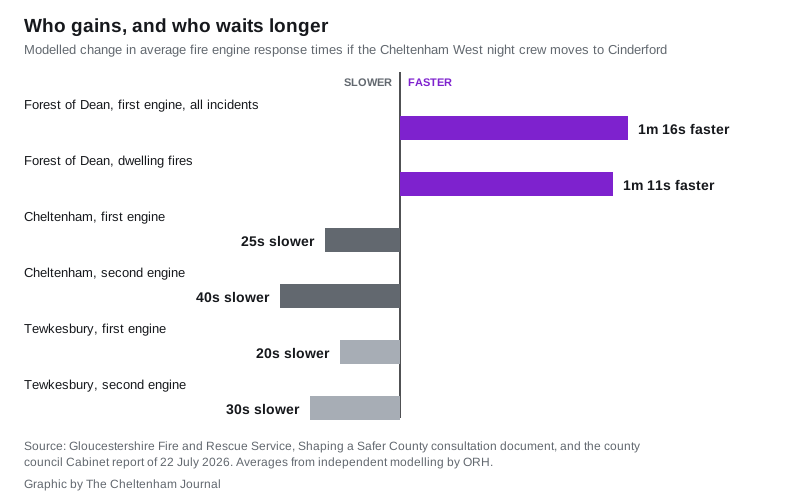
The consultation document sets out the trade-off in seconds:
| First engine | Second engine | |
|---|---|---|
| Cheltenham | 25s slower | 40s slower |
| Tewkesbury | 20s slower | 30s slower |
| Forest of Dean | 1m 16s faster | 1m 11s faster on dwelling fires |
The service says a 25-second increase “would still meet our Service attendance standard for dwelling fires of 9mins on average”.
The case for the Forest of Dean is the stronger half of the argument, and the council does not hide it. On average in 2025, on-call first fire engines in the Forest of Dean took around 14 and a half minutes to arrive. That is above the county average.
The modelling behind all this was done by Operational Research in Health Ltd, commissioned in late 2025 to analyse five years of service data. Its ranked list of wholetime stations that could lose a night shift with the least overall impact puts Cheltenham West first, ahead of Stroud, Gloucester South, Cheltenham East and Gloucester North.
Why this is happening now
Money. The fire service has to find £827,000 of savings over four years under the council’s medium term financial strategy.
The Cabinet report sets out three options:
- A1, do nothing. Cheltenham West stays 24/7, Cinderford stays on-call only, and the £827,000 has to come from somewhere else in the service
- A2, create 14 new posts at Cinderford. Cheltenham West is untouched. The report says this leaves the savings requirement unmet and creates “a significant recurring financial pressure”
- A3, move the 14 posts. Recommended, because it delivers the Forest of Dean improvement and the savings at the same time
Only A1 and A3 appear in the consultation booklet, as options 1 and 2.
The £160,000 option that is not in the consultation
The Cabinet report contains one thing the public consultation document does not.
Under “Additional Consideration”, it says that to mitigate the perceived risk of a reduction in service at night, “consideration could be given to implementation of an on-call unit at Cheltenham West overnight”. It prices this at “approximately £160,000 per annum based on a crew of 12 for nighttime cover only”.
That paragraph does not appear anywhere in the 24-page consultation booklet residents are being asked to respond to. Readers who want it considered will have to raise it themselves in the free-text answers.
The petition
The petition is titled “Stop night-time cover cuts at Cheltenham West Fire Station… Cuts Kill!” and was started on 3 August by Kate Yhnell. It argues that the town’s growth makes the case for keeping the crew:
The safety of our community in Cheltenham is at risk. With tens of thousands of new houses being built right next to Cheltenham and the new M5 junction opening, the decision to cut night-time cover at Cheltenham West Fire Station is not just inconvenient; it’s dangerous and potentially deadly.
It is not on the county council’s own e-petition register, which on 1 September listed one petition, about charges for DIY waste at recycling centres. Signatures are on change.org instead, so the council decides for itself what weight to give it.
The Cabinet report anticipated the reaction. It records that removing the night crew “may create concern among communities, staff and representative bodies about a perceived reduction in service, particularly at night, even though modelling indicates the operational impact is limited”.
What it means for you
The practical change, for anywhere Cheltenham West would currently reach first at night, is that after the day crew stands down the first engine comes from further away. The council’s own figure for that is 25 seconds on average for the first engine and 40 seconds for the second, across Cheltenham as a whole. It says that still meets its nine-minute standard for dwelling fires. The service does not publish a station-by-station boundary map, so we cannot tell you which streets are affected most.
To respond, by Monday 28 September 2026:
- online at gloucestershire.gov.uk/glosfireconsultation
- by paper questionnaire, requested from firecoverreview@glosfire.gov.uk or 01452 427554, returned free to GFRS Consultation, Opinion Research Services, Freepost SS1018, PO Box 530, Swansea SA1 1ZL
The consultation itself is costing the council about £35,000. Cabinet will consider the findings in December 2026 and can approve the change, approve it with amendments, or drop it. If approved, the new crewing model is expected during 2027. Upgrades to Cinderford fire station are in planning and expected to finish at the end of 2027.
One thing to note when you read the council’s case: fire cover is a county matter, so this is Shire Hall’s decision and not Cheltenham Borough Council’s. Our Cheltenham planning news page tracks the housing growth the petition refers to.
Have your say